

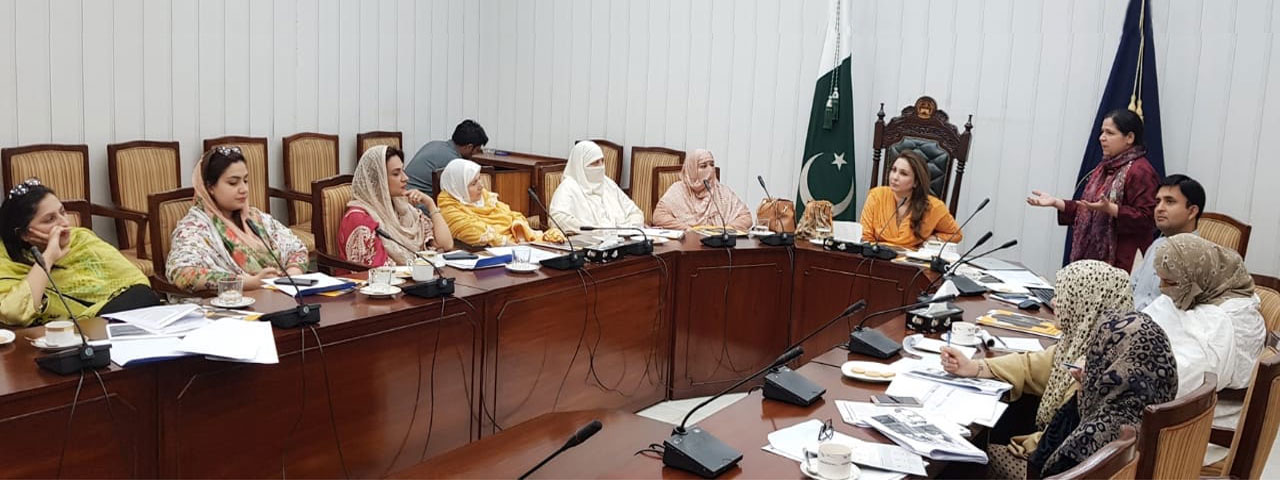

Center has been advocating with legislators from across Pakistan for making amendments to the Child Marriage Restraint Act 1929. In this respect, Center has reached out to Ms. Maliha Asghar Ali Khan who is Member Provincial Assembly and Chairperson of the Women Parliamentary Caucus for Khyber Pakhtunkhwa. With her support, Center delivered an orientation session on April 12, 2019 to members of the Women Parliamentary Caucus, Khyber Pakhtunkhwa, on child marriage in Pakistan from sociological and legal perspectives.
Ms. Shagufta Hameed Bhatti, Program Director, accompanied by Mr. Tahir Abbas, Advocacy Specialist, from Center held the orientation session that started with creating understanding of a ‘Child’ from the perspective of various legislations in Pakistan. Legislators were also provided with comparative provincial analysis of child marriages, especially of girl. This was followed by in-depth discussion on consequences and drivers of child marriage from the sociological perspectives. The discussion included societal perspectives also that perpetuate child marriage in Pakistan such as unavailability of health services, limited access to Lady Health Workers, curtailed agency of a girl child as well as gender hierarchies and norms, and the notion of chastity of a girl child.

Legislators were introduced to Pakistan’s international and regional obligations including the Khartoum Declaration and the resolution by Al-Azhar University as well as notes of the latest proceedings held by the Council of Islamic Ideology. The signed joint declaration by religious scholars, as a result of consultation with religious scholars organized by Center in 2017, was also shared and distributed. Lastly, comparative analysis of the various pieces of legislation on Child Marriage prevalent across Pakistan was discussed including various amendments put forth over the years by legislators, in terms of age of solemnization, who can take cognizance, punishments, and other salient features. Questions were answered during and after the session and an intensive discussion ensued amongst the members resulting in consensus on recommendations for major areas of the prevalent legislation i.e., Child Marriage Restraint Act (1929). Building on the work carried out over the years by civil society organizations, new recommendations were agreed upon and repealing the law was suggested as the way forward.
This initiative is part of project titled, ‘Promoting Legislation, Prompting Action to End Child marriage in Pakistan (Phase II)’ which is in its second year of implementation funded by AmplifyChange.