

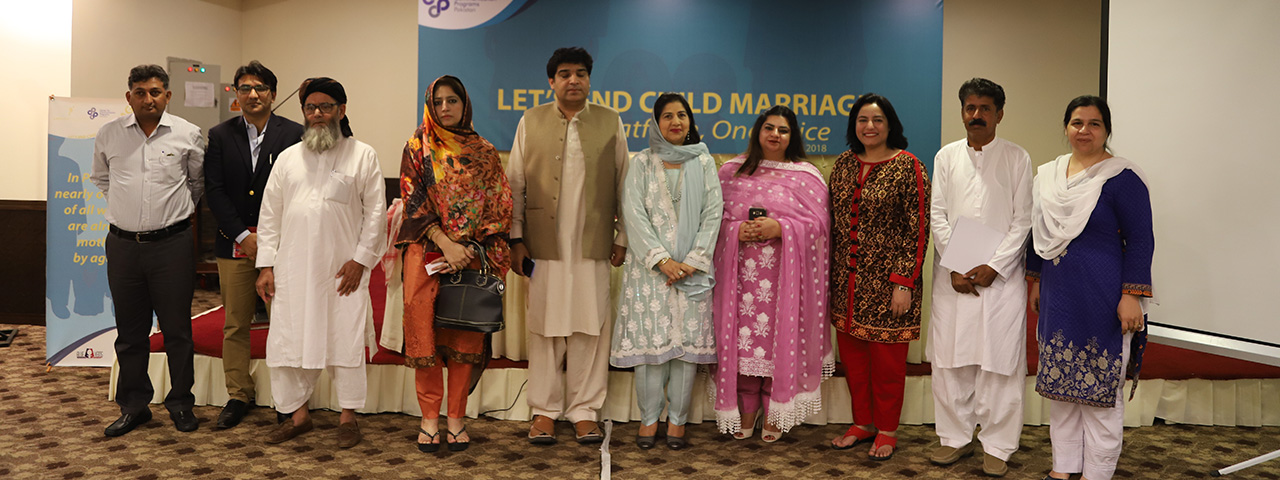
One Voice, One Platform, was launched in Islamabad on 25 April 2018 against the practice of child marriage in Pakistan. Center for Communication Programs Pakistan led the joint platform in collaboration with Bedari (Islamabad/Punjab), Blue Veins (Khyber Pakhtunkhwa), and Sujag Sansar (Sindh). The participants included representatives from civil society organizations as well as journalists. The event featured dissemination of advocacy toolkit against child marriage developed by the Center and advocacy material by other partner organizations. The platform also featured an animated video on child marriage, part of a social media campaign launched by the center recently.
The event featured subject experts as well as policy makers and legislators. Subject experts shed light on the health, social and economic impacts of child marriage in Pakistan. Dr. Najma Afzal Khan, MPA (PML-N), Punjab and a doctor, stated that infant mortality among girls married before 20 is 116 per 1000 births and reduces to 75 per 1000 births for women after 20. She further shared national statistics on maternal mortality among girls married between 15-19 years of age and shed light on restricted access of girls and women to health services. She further expounded upon the indicative trend of malnutrition among 15-19 years old in Pakistan which may lead to weak generations if child marriage is not eradicated in Pakistan.
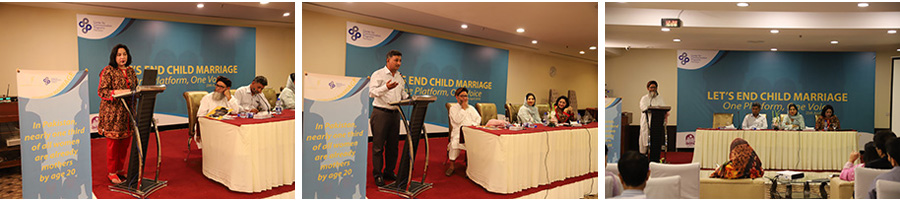
Ms. Anbreen Ajaib, a social activist and Executive Director Bedari, shed light on the impact of child marriage on education attainment, drop out as well as transition rate from primary to secondary, which ultimately translates to only 22 per cent girls participating in work force as adults. and work force participation. Maulana Mohammad Sharif Hazarvi, a renowned religious scholar shared the importance of a family unit in the light of Islam and sunnah and expounded upon the need for capacity of a girl and boy to manage the household along with physical maturity. He further stated that keeping in view the situation in Pakistan, state can legislate on the age of marriage. Mr. Waqar Aslam Bhatti, a senior journalist from Sindh, also a member of the monitoring committee on implementation of Sindh Child Marriage Act shared stories from the field and shared the drivers of child marriage in Pakistan as well as the role journalists need to play ion highlighting the said issue.
Ms. Rahila Khadim Hussain, MPA (PML-N), Punjab shed light of the legislative proposal tabled in Punjab Assembly. She shared that increase in age of marriage for girl is the key amendment presented. She further shared that it is currently with Minister of law for review. In terms of impediments, she shared that the rulings of Council of Islamic Ideology are a strong impediment. Mr Qamar Nasim, human rights activist, shed light on the Child Marriage Restraint Act (amendment) and shared that the said bill was not allowed to be presented in the provincial assembly as it was considered un-islamic as per the rulings of Council of Islamic Ideology and by other religio-political parties in the assembly.
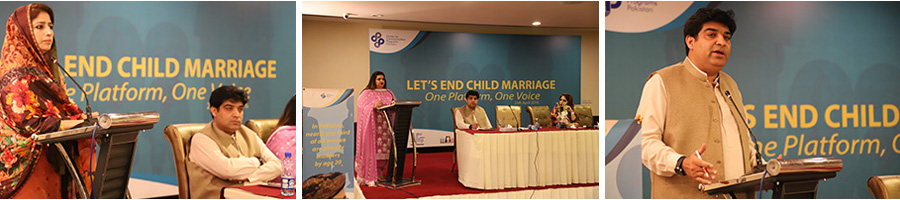
Ms. Rubina Qaimkhani, MPA (PPP), Sindh shared the salient features of the current legislation on child marriage in Sindh and expounded upon the impediments faced while debating the legislation. Sindh is the only province where a government bill on child marriage was presented and enacted increasing the age of the girl from 16 to 18 years.
She further shared that the party believes in upholding the rights of women and children. She also highlighted the need of comprehensive and holistic legislation on different issues pertaining to child rights.
Dr. Atif Ikram Butt, Executive Director, Center for Communication Programs Pakistan shared that Child Marriage is an issue of Pakistan and it impacts not only girls, our future generations but also the economy of Pakistan. He appreciated the efforts of civil society including religious scholars and journalists as well as policy makers in highlighting the issue.