

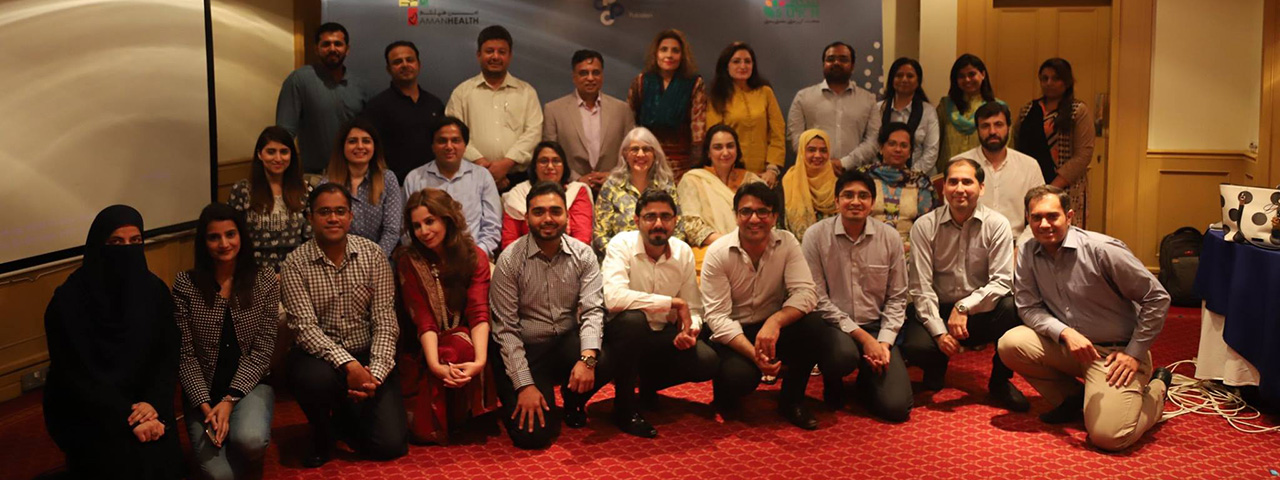
Center for Communication Programs Pakistan organized a two-day training for Sukh Initiative on Smart Chart on 14th and 15th March 2018 in Karachi. This training was second of the series. The first took place in Dubai that was co-jointly organized with the Workshop on Leadership in Strategic Communication.
The training aimed at building capacity on developing effective campaigns for a select group of 25 officials of Sukh Initiative consortium partners and Program Management Unit. Nearly two-third of the selected participants had attended the Dubai workshop during January 2018. The theme selected for the training was development of social media campaigns around ‘Responsible Adulthood’, which is one of the many components covered under Life Skills based Education (LSBE) being implemented by Sukh Initiative at various schools in Karachi.

Senior Regional Technical Advisor to Johns Hopkins Center for Communication Program, Fayyaz Ahmad Khan, conducted sessions on Smart Chart. He had the support of senior officials of Center for Communication Programs Pakistan, Ehtesham Abbas, Senior Media Advisor, and Dr. Atif Ikram Butt, Executive Director, who also facilitated sessions on ‘Social Media in Pakistan’ and ‘Recent Campaigning on Social Media’, respectively, in view of the selected theme for the training.
The training commenced with introduction to Smart Chart by Mr. Khan as a tool to develop effective campaigns. He also explained how Smart Chart compares with other communication tools, specially the p-process that is widely used for designing strategic communication programs for social behaviour. He then explained the event program and how the training will unfold in a combination of theory and practice to reveal the true potential of Smart Chart.

After the introduction, Mr. Ehtesham Abbas gave an engaging talk on the importance of social media and how it is shaping communication throughout the world today. He recounted the benefits of running social media campaigns for a wider outreach, especially to the marginalized women and children. He noted that the number of users of social media is growing at a very high rate and that it is conveniently possible to gauge and control the impact of any social media campaign, which also has the characteristic of two-way communication and dialogue. Mr. Ehtesham gave interesting facts about different social media use globally and nationally based on authentic data sources.  He also elaborated the difference between social media and social networking. To make his talk even more engaging he shared comparison of the number of users of some of the leading social networks. Participants took keen interest in the session and asked relevant questions. The session led to discussions on the potential use of social media. It also gave the chance to participants to initiate their thought process for their social media campaigns.
In the proceeding session, Mr. Khan cognized the participants about Smart Chart and its effectiveness and then ran them through its six steps for developing campaigns. Thereafter he expounded on the first three steps to building Smart Charts that involves taking program decisions, understanding the context and environment in which to operate, and making strategic choices especially with respect to the focused audience, its readiness to change and core concerns. He used relevant examples to make the participants understand concepts and theories.


Earlier, the participants were divided into four groups and were given exercises at the end of each step. The sub-themes selected by the participants themselves were (i) early child marriages, (ii) menstrual hygiene, adolescent girls, (iii) peer pressure and substance abuse, adolescent boys, and (iv) sexual harassment and abuse, adolescent girls. Being a hands-on training, facilitated by subject experts, the participants received instant inputs from the trainers on their group work that lead them to build their campaigns one step at a time.
On the day two, Dr. Atif Ikram conducted the first session and build on the talk given by Mr. Ehtesham to highlight the effectiveness of social media campaigns. He shared some of the recent and most successful social media campaigns that were well received by their audiences. He also correlated some of the key concepts and theories behind these campaigns.  After sharing the successful social media campaigns he elaborated the take-home messages of these campaigns. The session instigated a discussion on normative and empirical expectations from social media campaigns and touched upon certain innovations that can be made in social media campaigns.
Later during the day, Mr. Khan resumed training on creating a message, terming it the most essential part of developing any successful communication program. He also conducted sessions on the last three steps of Smart Chart, involving decisions to tactics and timings, resource allocation, gauging outcomes, and finally making a thorough reality check before proceeding with the campaign implementation.

The technical sessions concluded with participants making group presentation on their social media campaigns developed on their respective sub-themes around ‘responsible adulthood’. These presentations were also witnessed and appreciated by the Head of Sukh Initiative, Dr. Haris Ahmed and Ms. Shazina Masud, Executive Director Aman Health Care Services.
At the end, the participants were presented with certificates of participation. The event concluded on the note of taking forward these four campaigns to the implementation stage in the second half of the year.
